
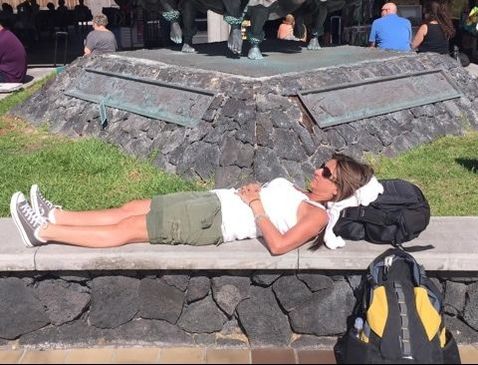
Janine enjoying life just like she deserves!
One of the best strategies to end up in remission from PPP is to exclude negative stress from your life - Asa I think most of us been told by our doctors that palmoplantar Pustulosis is a genetic and chronic (not treatable) skin disease.
The below PPP Success story by Janine is evidence to the contrary. I hope Janine’s story will help and inspire the readers of my blog to get started on your own health/recovery journey by showing that it is possible to get rid of PPP after all.
I would also love to hear from other fellow Palmoplantar pustular psoriasis sufferers who has manage to clear this horrible disease with either conventional medicine or using a natural holistic approach. Our gathered experiences can help and spread the word that PPP does not have to be a fact of life. If you want to share your own story to the world please contact me, there are so little information about this disease out there and it's a great support to read about others in the same boat. Take care and do get in contact.....I would love to hear from you....now...over to Janine :) Åsa Kärrman
Asa,
I think I found your blog one desperate night in the summer of 2014. I have PPP on my right foot. I am 50 years old but it started in 2013 when I was 46. I had no idea what it was. I have learned over the years that it is best to search for a holistic alternative to traditional western medicine. This is why I was trolling the internet, literally typing in "bottom of foot itchy", Some how my crazy random google words led me to your blog. I have been trying to figure out for years how to find you to thank you. The book you wrote is a GIFT to anyone and everyone that is seeking answers and help. First of all and before I share my story and how I put PPP and arthritis into remission I want to say THANK YOU Asa. I was so desperate for an answer. Your story all of those years ago reinforced my inclination to go the holistic route. You literally saved me months, possibly years of uncertainty and pain. Not to mention thousands of dollars in Dr. Visits that were not going to help at all. I was so depressed, so exhausted from lack of sleep due to the pain and itching. I cried all of the time and I just wanted to curl up in a ball and stay like that forever.
So here it is for all of you ladies out there looking for hope. And again I would not be where I am today without Asa. Also, like Asa says your have to be patient, take the time to find the combination that works for you.
As I said above I discovered PPP on the bottom of my right foot when I was 46 years old. I also had a rash on my right elbow, with joint pain, and joint pain in my right thumb. I am a smoker. I do not drink alcohol, sugary drinks, or processed foods. I live in a area where we don't have fast food. Im average weight and I do like to run. I eat pretty healthy and clean, if its not certified organic its not in our house. I do LOVE hot peppers but have mostly given them up as I noticed when I cut them out it made difference in the severity of the PPP breakouts. I have a very high stress job. At the time this all started to manifest I was probably in one of the most stressful periods of my life. I started with a supplement regiment immediately after reading the blog. I have not quit smoking (I would love to someday) It took me a year to get the supplements right but that was because Asa had not written her book yet and Im sure she was still learning too!. I began taking Moducare, Wobensym, a multi vitamin, CoQ10, Probiotic, Silver water. After 60 days nothing had changed but nothing had gotten worse and yes I was still dealing with the stress. I discovered I had to be patient and tweek the supplements. I wont bore you with everything I tried that did not work, I will tell you what did work, and still does work. I know its not the healthiest thing in the world but I don't eat breakfast. I never have. I don't recommend not eating breakfast. I take the supplements in the morning and they fill me up because there are so many of them. I take some of the same supplements at night before bed. The brand I have here in the US is Sports Research 100% organic non-GMO I buy them on Amazon. Once I got the combination right, it took less than 60 days for the PPP and arthritis to go into full remission. -Probiotic, I switch them up each time I need a new bottle, I buy the type that need to be refrigerated and I try to get a dosage with not less than 20 billion. 1 a day before bed -Biotin 5000 MG in the morning and before bed -Vitamin D3 in the morning and before bed -Vitamin K2 in the morning and before bed -Vitamin A in the morning and before bed -Vitamin C in the morning -Moducare in the morning -Silver Water in the morning -Magnesium 2000 mg in the morning (too much can give you diarrhea so be careful when you first start with this. -Turmeric Cur cumin The brand is from Sports Research they have the perfect blend, and its important to have the right blend or your body will not absorb it properly. (this is a god send and helps with ALL kinds of inflammatory issues related to Auto Immune. After less than 30 days of taking this the joint pain and rashes were completely gone. -three times a week I drink a glass of psyllium husks (organic) mixed with Bentonite Clay (liquid) Its not the most pleasant thing in the world but it does really help pull toxins and flush them out of the colon. Im happy to say its gone! All of it, the rashes, the PPP, the joint pain, the acne, gone. I know it all lurks there under the surface waiting for me to get stressed out, give up on the supplements or go eat a giant tub of the hottest salsa ever made. The fact that I now control it, and it no longer controls me is the greatest feeling ever. I know this can seem overwhelming, but if you are all like me, you are willing to try anything to get some relief. Read Asa's book, it will explain so much more of the what, why, how. Her story is amazing, its incredible that she wanted to take the time to share it with all of us out here. Be kind to yourself. Janine Read More Palmoplantar Pustulosis Success Stories
17 Comments
Andrea
7/15/2017 06:14:50 pm
I have been suffering from ppp for about 8 years now. It started on my right foot and eventually moved to both palms. I am a smoker. I purchased your book about 4 months ago and have continued to tweek my supplements in an effort to put this into remission for good. I am just about clear except for a tiny area on my right palm. I am struggling to find beverages to drink besides water. I have tried unsweetened tea, kombucha for the fermentation,but that causes me to break out as well. Can anyone suggest another beverage alternative? Asa, thank you so much for your book!! This disease can be controlled, don't give up! 7/17/2017 11:44:21 am
Hi Andrea
Andrea
7/20/2017 04:16:31 am
Asa,
Clif
4/26/2021 04:43:35 pm
Hi. I had palmoplantar pustulosis. I tried many treatments. What worked for me was very simple. Coal tar shampoo (Art naturals) and a sort of exfoliating sponge (sort of like a curved sanding block for feet). I lathered the soles of each foot and basically removed the dead cracked skin withe the exfoliator. More coal tar more exfoliating. Don't over do it! Same with palms of hands. I did this 2 or three times per week in the shower. Very uncomfortable and tender at first but very quickly I could see it was working. Use a cooling foot cream like mint after drying. Simple. I am certain it worked for me in just a few weeks. Try it before taking medicine. 7/26/2017 08:57:43 pm
Hi Andrea,
Andrea
8/4/2017 05:47:23 am
Asa, 8/14/2017 07:25:07 pm
Hi Andrea,
Michelle Clement
4/20/2018 03:50:23 pm
Hi Asa, 5/13/2018 09:42:48 pm
Hi Michelle,
Michelle
5/14/2018 07:09:57 pm
Hi Åsa, 5/20/2018 07:35:26 pm
Michelle,
Judie Derouin
7/1/2018 11:55:53 am
I have just found this site and feel hopeful again. I am going to finish the book but wanted to jump on here quickly to say *Thank you*! Judie
Judie Derouin
7/1/2018 09:56:52 pm
Finished the book and it give me hope. I have been dealing with this for 3 + years and in some days brings me way down. My right side hand and foot seems to be more active then my left side. It is slowly getting worse. But this is a good start. The only thing I am confused/concerned about is the supplements. I am not sure how to dose them out and can you take too much? I know everyone is different yet could you suggest or say what dosage you take or what to start with?
Angie
11/2/2018 03:28:34 am
Hi,
Grainne
11/13/2018 08:37:11 pm
Hi Asa
Laurina Mayenburg
7/2/2020 01:33:52 am
I've been struggling with this disorder for about 20 years or more, and seeing your writings is giving me hope, it is just so very hard to get anyone including doctors to take this seriously. My quality of life really has been profoundly affected, my feet are so bad, my hands are ok though. I only had a few minor outbreaks on my hands, but feet are a constant struggle. Can't do any formerly loved weight-bearing activities. You give me hope, and I will further pursue it with my doctor and pharmacist, try to see a specialist, and get some nutritional counselling. My pharmacist is good, and he works together with a naturopath, so maybe it's worth another go. Thanks 7/2/2020 06:41:31 pm
Hi Laurina, Leave a Reply. |


If you want to heal your palmoplantar Pustulosis naturally, Do get a copy of my book where I teach in detail how to succeed and how to end up in remission long term.

Get my free booklet outlining the foods you can eat and which ones to avoid while healing from PPP . Enter your email address below and click subscribe.
1. Why is it so difficult to diagnose Palmoplantar Pustulosis? |
 RSS Feed
Disclaimer and privacy policy terms:
Read our GDPR privacy policy here
The information and advice published or made available through the www.well-healed.com web site is not intended to replace the services of a doctor nor does it constitute a doctor-patient relationship. Information on this web site is provided for informational and educational purposes only and is not a substitute for professional medical advice. You should not use the information on this web site for diagnosing or treating a medical or health condition. You should consult a physician in all matters relating to your health, and particularly in respect to any symptoms that may require diagnosis or medical attention. Any action on your part in response to the information provided in this web site is at the reader’s discretion. Readers should consult their own doctors or naturopaths concerning the information on this web site. www.well-healed.com makes no representations or warranties with respect to any information offered or provided on or through the www.well-healed.com web site regarding treatment, action, or application of medication or therapies. www.well-healed.com is not liable for any direct or indirect claim, loss or damage resulting from use of this web site and/or any web site(s) linked to/from it. Well Healed is a participant in the Amazon Services LLC Associates Program, an affiliate advertising program designed to provide a means for sites to earn advertising fees by advertising and linking to amazon.com.
Read our GDPR privacy policy here
The information and advice published or made available through the www.well-healed.com web site is not intended to replace the services of a doctor nor does it constitute a doctor-patient relationship. Information on this web site is provided for informational and educational purposes only and is not a substitute for professional medical advice. You should not use the information on this web site for diagnosing or treating a medical or health condition. You should consult a physician in all matters relating to your health, and particularly in respect to any symptoms that may require diagnosis or medical attention. Any action on your part in response to the information provided in this web site is at the reader’s discretion. Readers should consult their own doctors or naturopaths concerning the information on this web site. www.well-healed.com makes no representations or warranties with respect to any information offered or provided on or through the www.well-healed.com web site regarding treatment, action, or application of medication or therapies. www.well-healed.com is not liable for any direct or indirect claim, loss or damage resulting from use of this web site and/or any web site(s) linked to/from it. Well Healed is a participant in the Amazon Services LLC Associates Program, an affiliate advertising program designed to provide a means for sites to earn advertising fees by advertising and linking to amazon.com.